

4K IPTV brings Ultra High Definition video to internet TV, changing how we watch live sports, movies, and series. It offers a 3840 × 2160 resolution, making images sharper and colors richer than traditional TV. Apps like IPTV Smarters and TiviMate make it easy to watch on devices like Android TV boxes and smart TVs.
TV over internet protocols means you can watch live, on demand, or later without satellite limits. Croatia’s growing fiber and high-speed broadband make 4k iptv a great choice for better picture quality and more options. Providers need to ensure their apps work well on different devices and browsers.
In Croatia, the future of streaming depends on network reach and device support. With the right setup, 4K IPTV brings cinema-like visuals home. It also offers a wide range of international and local channels, making streaming more immersive and on-demand.
Key Takeaways
- 4K IPTV delivers Ultra High Definition (3840×2160) TV over internet protocols for sharper images and lifelike colors.
- Popular apps and devices like IPTV Smarters, TiviMate, Android TV, and Fire TV support 4k iptv playback.
- Croatia’s expanding fiber and high‑speed internet make adoption of 4K UHD IPTV realistic for many households.
- Reliable web portals and cross‑browser compatibility are essential for consistent service access.
- 4K IPTV combines live TV, VOD, and time‑shifted content to define the future of streaming.
What 4K IPTV Means for Croatian Viewers
Streaming in 4K changes how Croatians watch TV at home. Faster networks and better devices make high-resolution feeds practical for more households. Viewers get sharper images, richer color and a cinema-like feel for sports, news and films.
Definition and core benefits
4K IPTV delivers television over internet protocols at 3840×2160 resolution. This higher pixel density boosts texture and contrast, giving a clearer picture on large screens. Core perks include wide channel variety, access to international premium sports and movie feeds, deep on-demand libraries and lower monthly costs versus many cable plans. Multi-device support, user profiles and parental controls add flexibility that suits family routines.
How 4K resolution improves local content and international channels
Local broadcasters and regional producers gain when UHD local channels appear alongside global networks. News footage looks crisper, studio sets show finer detail and sports broadcasts reveal smoother motion. International channels benefit from the same clarity, making foreign films and live events feel more immediate and engaging for Croatian viewers.
Why Croatia’s broadband growth matters for adoption
IPTV depends on packet delivery, so reliable broadband is crucial. Most 4K streams work best with at least 25 Mbps per stream. Croatia’s expanding fiber and 5G footprint lowers buffering and improves live-event reliability. As Croatian broadband spreads, the pool of households ready for 4K IPTV Croatia will grow quickly.
| Feature | Impact for Viewers | Practical Tip |
|---|---|---|
| Resolution (3840×2160) | Sharper images, better color depth for movies and sports | Use a native 4K TV and set display to 4K output |
| Bandwidth need | Minimum ~25 Mbps per stream to avoid buffering | Prefer wired Ethernet or stable Wi‑Fi 6; check ISP plan |
| Content variety | More UHD local channels and international offerings | Compare provider lineups for key channels and VOD |
| Device compatibility | Requires modern browsers, apps or set-top boxes | Allow necessary scripts in browser and disable blocking that breaks portals |
| Cost and flexibility | Often lower cost than cable with on-demand features | Try provider trials to test picture and support |
Technical Basics of IPTV Delivery
The move from cable and satellite to internet streaming changes how we watch videos. IPTV sends video as IP packets over the internet. Unlike cable and satellite, IPTV uses the internet to adapt quality and add on-demand content.
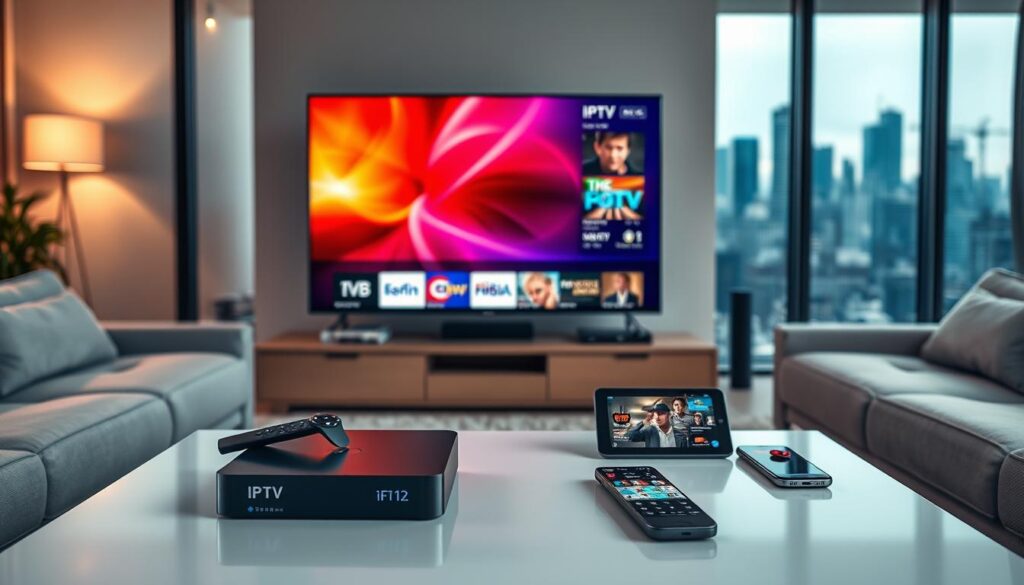
How internet protocol streaming differs from cable and satellite
Traditional broadcast is tied to physical infrastructure. IPTV breaks this tie, treating each channel as data. This makes channel changes faster and adds interactive features.
IPTV uses routers, ISP routes, and app players, not coax or dish alignment.
Encoding, packet delivery, and common codecs used for UHD
Video needs encoding before it travels. For 4K, efficient compression is key. Many providers use HEVC (H.265) instead of H.264.
AV1 is also becoming popular for even more bitrate savings without losing quality.
Once encoded, video is split into packets and sent over UDP or TCP. Adaptive bitrate streaming adjusts to available bandwidth. A good player design is crucial for smooth playback.
Role of multicast, CDN and server infrastructure in stable playback
Multicast IPTV saves bandwidth by sending one stream to many on the same network. IGMP controls group membership at the router level. This makes delivering live channels efficient.
CDN for IPTV and edge servers reduce latency and spread the load. Edge caching places streams near viewers. A well-designed CDN supports large audiences without buffering.
For reliable 4K playback, use modern codecs, multicast IPTV, and distributed servers. This combination reduces bandwidth waste and ensures steady streams for Croatian viewers.
4K Picture Quality: What Makes It Better
Switching to 4K changes how we watch TV. It has four times the pixels of Full HD, at 3840×2160. This makes textures, edges, and details clearer on modern screens.
Color depth and HDR add richer tones and better contrast. Scenes look more lifelike without extra processing.
Resolution, pixel density, color depth, and perceived sharpness
More pixels mean higher pixel density on the same screen size. This creates clearer lines and finer textures in faces, fabrics, and backgrounds. Viewing distance is key.
At closer ranges on large screens, 4K reveals details that Full HD hides.
Color depth and HDR boost perceived sharpness beyond raw pixels. Better color gradations reduce banding and make shadows and highlights more realistic. These improvements enhance 4k iptv sharpness in real-world viewing.
Benefits for sports, movies, nature and fast-action content
Sports gain from extra detail during high-speed plays. You can follow a ball or puck and see player numbers more clearly. Fast-action camera pans keep more detail when encoded properly.
Movies and nature films benefit from richer textures and depth. Landscapes and close-ups feel more immersive. For documentary lovers in Croatia, UHD content highlights subtle visual cues that Full HD can miss.
Comparison with Full HD and expectations for future 8K
UHD vs Full HD is a clear technical leap. Full HD remains serviceable for small screens and casual viewing. 4K is the premium standard for home theaters and larger TVs.
The 8K future is on the horizon, with displays like Samsung and LG pushing pixel counts higher. AI-driven upscaling will smooth the move to 8K by improving older content. Network upgrades and device support will shape when 8K becomes mainstream.
Required Home Setup for True 4K IPTV Playback
To get a great 4K IPTV experience, you need the right equipment and a clean network. Choose a 4K/UHD TV that supports HDR and HDMI 2.0 or newer. Make sure your TV’s display settings are set to native 4K output.

Browser and app behavior can impact playback. Turn off aggressive ad blockers for smart TV web apps. Also, ensure the TV or browser allows necessary scripts. If you use built-in apps, check for firmware updates from Samsung, LG, Sony, or Panasonic to keep 4K performance optimal.
4K/UHD television and display settings to enable 4K output
Set your TV to the correct HDMI input mode for 4K at 60Hz. Turn on HDR settings when available. Choose the highest color profile supported. Use guides from Sony, Samsung, or LG to confirm settings for native 4K apps and external boxes.
Internet speed and bandwidth recommendations for 4K streaming
Live 4K feeds require steady throughput. Aim for a minimum 4k iptv internet speed of 25 Mbps per stream. For families with multiple viewers, choose 50 Mbps or more to provide headroom and reduce buffering during peak times.
Prefer wired Ethernet for the primary device. A stable broadband connection with low latency is crucial during big live events. Test your ISP plan and pick one that matches household habits.
Compatible devices and apps: set-top boxes, smart TV apps, and players
Use devices known for reliable 4K playback: Formuler and MAG set-top boxes, Amazon Fire TV Stick 4K, NVIDIA Shield, and Android TV boxes. Popular compatible IPTV apps include IPTV Smarters, TiviMate, and XCIPTV. Check app settings for 4K support and hardware decoding.
Choose HDMI 2.0+ cables and ensure your set-top box or TV has sufficient CPU and DRM support for UHD streams. When possible, run the set-top box on wired Ethernet. Keep the smart TV app updated to maintain compatibility and smooth playback.
Choosing a Reliable 4K IPTV Provider
Finding the right provider is key to a great 4K viewing experience. Look for clear technical specs, public channel lists, and quick support. This way, you can test streams on your home connection before you commit.
What to check before you subscribe
Make sure the provider offers true 4K streams and lists the required bitrates. The server’s capacity and location affect how well it works. A good IPTV EPG makes it easy to find and plan your channels.
Check if the service works well on Android TV, Amazon Fire TV, and web players. Avoid services that use weak browser scripts or don’t clearly state their app versions. Also, look for features like anti-freeze and limits on streaming on multiple devices.
Legal standing and content licensing
Choose licensed 4k iptv services that clearly state their rights and sources. Licensed providers are less likely to shut down or lose content. Unlicensed services might be cheaper but come with legal risks and service issues.
Make sure the provider names the rights holders and shows official agreements. This transparency lowers the risk of content takedowns and ensures access to premium content.
How to verify provider quality
Start with IPTV trials Croatia offers to test how well it works on your network. Free trials let you check if the EPG is accurate, if start times are right, and if catch-up works on your ISP.
Read recent user reviews on forums and app stores. Look for feedback on stream stability and customer service. Try sending a support request to see how fast they respond before you pay.
| Check | Why it matters | What to test in a trial |
|---|---|---|
| 4K bandwidth support | Ensures true Ultra HD quality at peak scenes | Play live sports and fast-action movies to watch for stutter |
| Server stability & CDN | Reduces buffering and regional outages | Stream during local prime time to test load handling |
| IPTV EPG quality | Improves navigation and catch-up reliability | Check program times, metadata, and search function |
| Licensed status | Protects against legal takedowns and service loss | Ask for channel license lists or partner statements |
| Customer support | Speeds troubleshooting and resolves playback issues | Test support response during a trial with a technical question |
| Trial availability | Lets you confirm real-world performance | Use an IPTV trials Croatia offer to check local networks |
Choose providers that are open about their tech, offer trials, and have clear support channels. This ensures a reliable 4K IPTV experience for Croatian viewers without surprises.
Streaming Features that Enhance the 4K IPTV Experience
High-quality streaming is more than just high resolution. Croatian viewers benefit from smart playback tools, vast libraries, and network-aware delivery. Choosing a service with modern 4K IPTV features makes watching smoother and more fun.
Video on Demand, catch-up TV, and time-shift functionality
On-demand libraries let families watch movies and shows whenever they want. Look for services with clear categories, subtitles, and reliable metadata for easy searching.
Catch-up TV keeps recent broadcasts available for 24–72 hours. Time-shift tools let users pause or rewind live channels. These features make busy schedules more flexible for viewing.
In Croatia, popular local channels and a wide 4k iptv VOD catalog offer both national and international content without compromise.
Multi-screen streaming, simultaneous streams, and user profiles
Multi-screen setups allow different rooms and devices to stream separately. Families can save by choosing plans with multiple simultaneous streams.
User profiles add parental controls and tailored recommendations. Profiles help manage viewing limits and keep kids on age-appropriate channels.
Apps that sync watch history and favorites across devices make switching easy.
Anti-freeze/low-latency tech and adaptive bitrate streaming
Anti-freeze systems detect stalled frames and switch to cached segments or lower-bitrate copies to prevent long pauses. Low-latency modes are crucial for live sports and real-time events.
Adaptive bitrate IPTV adjusts quality to match current network conditions. When ABR pairs with CDN edge servers, buffering drops and startup times shrink.
Choose providers that advertise explicit low-latency options and proven adaptive bitrate IPTV methods for dependable 4K playback, especially during peak hours.
Practical takeaway: prefer services that combine 4K IPTV features, a robust 4k iptv VOD library, and adaptive bitrate IPTV for a responsive, high-quality experience in Croatian homes.
Common Issues with 4K IPTV and Practical Fixes
Streaming 4K content offers great detail and clarity. But, it can also cause a few common problems. This guide will help you fix these issues at home. Start by checking your network, hardware, app settings, and provider status for the best results.
Buffered playback often means your network is too slow or the servers are too busy. Try using a wired Ethernet connection. Test your internet speed and compare it to what your provider recommends for 4K. If you only have Wi-Fi, move your router closer or use a dual-band setup to reduce buffering.
Some providers might not offer true 4K streams or might throttle them. If you still see buffering on different devices, contact your provider. They should confirm if they offer 4K and check their server health. If problems keep happening, think about switching to a provider with a stable CDN and multicast support.
Buffering causes and solutions
Slow internet, crowded Wi-Fi, or too many users on the server can cause buffering. Try switching to Ethernet, getting a faster ISP plan, or downloading big files when you’re not watching. Test if the problem is with your device or the server by playing on another device.
Audio/video sync and playlist errors
IPTV sync issues can make sound delayed or out of sync with video. Try restarting the app or device. Use a different player app like VLC or TiviMate. Make sure your TV’s firmware is up to date. If a channel won’t load, check the playlist URL and provider status. Server maintenance or wrong playlist formatting often causes missing channels.
Hardware limits and compatibility
Not seeing 4K output might be due to TV settings, HDMI cables, or app limits. Ensure your display is set to 4K/60Hz. Use HDMI 2.0 or higher cables. Check if your set-top box supports UHD. Replace old HDMI 1.4 cables and confirm the streaming app supports 4K on your device.
Browser or web portal problems can stop playback. Enable JavaScript, disable ad-blockers and privacy extensions, or use Chrome, Edge, or Firefox for a supported experience. If scripts fail often, try the native app on a smart TV or Android TV box.
Here’s a quick checklist for 4K IPTV troubleshooting: check your network speed, use wired connections, swap cables for HDMI 2.0+, restart apps and devices, test multiple players, and confirm provider 4K status. These steps help reduce buffering and solve most sync issues before you need to contact support.
| Issue | Likely Cause | Quick Fix |
|---|---|---|
| Frequent buffering | Slow ISP plan, Wi-Fi congestion, server overload | Switch to Ethernet, upgrade plan, test other provider servers |
| Audio lag or lip sync | Player app glitch, device codec mismatch | Restart app, use alternate player, update TV firmware |
| Channel not loading | Playlist URL error or provider maintenance | Reload playlist, confirm URL, contact provider support |
| No 4K output | TV not set to 4K, HDMI cable too old, provider not offering 4K | Enable 4K mode, use HDMI 2.0+, verify provider 4K capability |
| Web portal fails | Blocked scripts or unsupported browser | Enable JavaScript, disable blockers, use supported browser |
Cost Comparison: 4K IPTV vs Cable and Satellite in Croatia
Choosing between traditional pay TV and internet-delivered options often comes down to price, channels, and flexibility. This section outlines how monthly bills stack up, what typical offerings include, and why many households in Croatia consider switching.
Pricing models vary across providers. Many IPTV plans use tiered subscriptions that bundle standard channels, premium sports, and 4K feeds. Pay-per-view options and on-demand libraries appear as add-ons. Trial periods and short-term passes help verify service quality before committing.
Typical 4k iptv pricing in Croatia ranges from low-cost basic plans to higher tiers that include multiple simultaneous streams and UHD channels. A fair comparison looks at per-month fees, setup or hardware costs, and whether international channels or sports packages are part of the base fee.
When comparing IPTV vs cable Croatia, IPTV often wins on flexibility. Cable and satellite packages usually lock customers into larger bundles with long-term contracts. IPTV avoids heavy infrastructure costs, so providers can offer smaller, targeted packages that lower monthly outlay for many homes.
For households that need multilingual or international channels, 4K IPTV cost Croatia can be lower overall. IPTV providers commonly include wide regional channel selections and on-demand content without the premium markups found on traditional platforms. This makes streaming attractive for families with diverse language needs.
Value depends on viewing habits. Sports fans who want premium live events in UHD should check whether a provider includes those feeds or charges per event. Casual viewers focused on movies and series may find cheaper packages with strong on-demand catalogs and reliable 4K playback.
Before switching, test the service. Confirm trial availability, check live 4K streams on your home network, and review customer support policies. That step prevents surprises in both quality and final monthly costs when comparing 4K IPTV cost Croatia and 4k iptv pricing against cable or satellite options.
Practical takeaway: for many Croatian households, an IPTV plan can cut monthly bills while expanding channel choice and offering true 4K quality—especially where international content matters most when weighing IPTV vs cable Croatia.
Device and App Ecosystem for 4K IPTV
Choosing the right hardware and software is key for enjoying 4K video. This guide will help you find reliable apps and compatible devices. It also covers the difference between streaming on phones and big screens.
Look for apps that update often and support 4K. In Croatia, IPTV Smarters Croatia and TiviMate 4K are popular. They offer features like flexible playlists and EPG. Make sure web portals work well on modern browsers.
For smooth 4K, choose devices that handle HEVC/H.265 and HDR. Consider Formuler, MAG boxes, Android TV boxes, and Amazon Fire TV/Firestick. Many smart TVs also support 4K and HDR. Always check device specs before you buy.
Mobile devices often stream in lower quality to save bandwidth. This means 4K isn’t as important on phones and small tablets. But for big screens, 4K is crucial for a better viewing experience.
Streaming apps have different features. Choose ones that clearly state HEVC and HDR support. They should also offer adaptive bitrate and reliable EPG and parental controls. Try a provider’s trial stream to test playback before you buy.
- Devices to consider: Formuler, MAG, Android TV boxes, Fire TV/Firestick, recent smart TVs.
- Apps to try: IPTV Smarters Croatia, TiviMate 4K, XCIPTV for playlist and EPG flexibility.
- Key specs: HEVC/H.265, HDR support, strong codec compatibility, active developer support.
In Croatia, balance cost and quality when choosing 4k iptv devices. Mid-range devices often offer the best value. Make sure apps and devices support 4K/HEVC/HDR. Try a short trial before upgrading your setup.
Security, Legal and Licensing Considerations
Choosing a reliable service is key for long-term 4K viewing. Licensed 4K IPTV offers clear rights, steady channels, and visible company details. This shows the provider follows distribution rules. Look for contact emails, business addresses, and fast support to reduce the chance of sudden takedowns or interruptions.
Copyright and provider reliability
Providers with proper rights buy content from broadcasters and studios. This means fewer shutoffs and a better chance that sports, movies, and news stay on air. Unlicensed services may appear cheap but carry risk of legal action and service loss.
Account safety and IPTV privacy
Secure connections matter for account safety. Use services that offer HTTPS, encrypted streams, and two-factor authentication when available. Protect passwords and avoid sharing credentials to keep your subscription safe. Read privacy policies to confirm how viewing data and personal details are handled.
Regulatory checks for Croatian users
Croatian viewers should check national and EU rules before subscribing. Clear licensing helps with compliance on content rights and reduces exposure to issues tied to 4k iptv legality Croatia. Choosing providers that follow EU audiovisual rules lowers the chance of regional blocks or fines.
Practical takeaway: prioritize licensed, well-documented providers with visible support channels and strong security measures to protect viewing quality, privacy, and legal standing.
| Factor | What to look for | Why it matters |
|---|---|---|
| Licensing | Written rights, contracts with studios or broadcasters | Reduces channel drops and legal risk |
| Support and transparency | Public contact email, business address, responsive helpdesk | Fast resolution for outages and billing issues |
| Security | HTTPS, encrypted streams, two-factor login | Protects accounts and viewer data |
| Privacy policy | Clear rules on data use and retention | Ensures IPTV privacy and regulatory compliance |
| Regional compliance | Operator alignment with EU and Croatian media law | Addresses 4k iptv legality Croatia concerns and prevents takedowns |
Future Trends Shaping 4K IPTV
The future of streaming will change how we watch TV in Croatia. Upgrades to networks, smarter cloud services, and better displays will open new doors. These changes will make high-quality viewing more common in every home.
Network improvements
More fiber and 5G will cut down on delays and increase capacity. This is great for live sports and watching TV in different rooms. With faster connections, households can watch multiple 4K streams without any issues.
AI and cloud-based improvements
Cloud CDN and distributed encoding make devices work less hard. Real-time AI upscaling and optimized codecs save bandwidth while keeping quality high. Devices from Samsung, LG, Apple TV, and Android boxes will use AI to make lower-quality sources look better.
Emerging formats and display roadmap
HDR, higher frame rates, and immersive audio will soon be standard. As technology advances, 8K trials will start, pushing service providers and makers to test new paths. Broadcasters and OTT platforms will plan updates that won’t break apps or portals.
- Cloud-first delivery improves resilience and scaling for regional providers.
- AI recommendation engines boost engagement and help users find local Croatian and international content.
- 5G and fiber together make 4K mobile viewing and home multi-streaming more realistic.
For Croatia, wider fiber and 5G, plus cloud and AI tools, will make things easier. People should expect smoother apps, better recommendations, and less buffering as 4K IPTV’s future unfolds.
Conclusion
As broadband in Croatia grows and smart TVs become more common, 4K IPTV becomes more appealing. It offers smooth playback thanks to technical strengths like adaptive bitrate delivery. Services like video on demand and catch-up TV also add flexibility, beating cable and satellite.
Practical steps are key: aim for at least 25 Mbps per 4K stream. Choose providers with solid trials and clear device compatibility. Use apps that handle UHD codecs well. IPTV’s delivery model works across phones, tablets, and living-room setups, offering multi-device access without extra costs.
The future for Croatian viewers looks bright. With fiber rollouts, growing 5G coverage, and an evolving provider ecosystem, 4K IPTV will focus on live sports, movies, and local programming in true UHD. This makes 4K IPTV a top choice for premium, flexible, and cost-effective TV today.